Thursday, August 19, 2010

Dot Net Project: Visual LINQ Query Builder - VS 2008 Add-In

Visual LINQ Query Builder - VS 2008 Add-In

Visual Linq Query Builder helps you create Linq to SQL queries for your programs(Support for C# and VB projects is provided) and demonstrates how to create their own Visual Studio 2008 add-in by using WPF.

Here are some screenshots of Visual Linq Query Builder in designer mode

clip_image016_2

clip_image018_2

Download Visual LINQ Query Builder and documentation

Tuesday, August 3, 2010

Web 3.0 | PERSONALIZE MEDIA

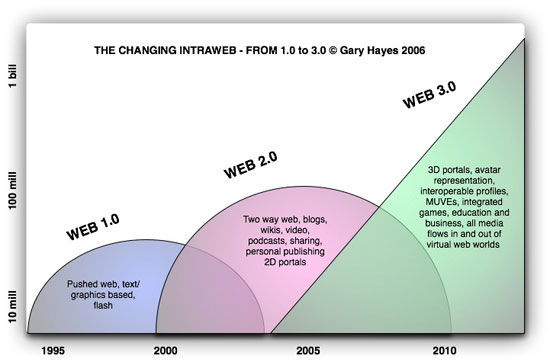
I have posted prolifically about MUVE’S (Multi User Virtual Environments) in the past, concentrating mainly on the ever customisable . It is interesting to watch the buzz spreading and consider if virtual worlds are really web 3.0, I think so. A quick look at the evolution of the intraweb from the mid 90′s. From text and graphics dominate 2D environments, immersive web quickly followed combined with ubiquitous communication via IM and IRC chat. Then the early 00′s with the expontential growth of self publishing, blogs and wikis. From 2002 onwards the massive sharing social network communities of flickr and YouTube in sync with the explosion of portals containing all of the above in services such as MySpace, Yahoo and MSN etc: We are heading towards a rich media personal hub that points to and houses all of our ‘shareable’ content. But the current 2D web, mostly linear to linear linking, is about to be enhanced by virtual environments in which we meet as avatars, interact as 3D moving objects that takes sharing, co-creation and communication to the next, predictable level. The important component here is real time collaboration and communication as the paradigm shift.


Web 1.0 to 3.0

Web X.0. To me evolution of the web can be defined in single sentences:

    1.0 the pushed, one way only web
    2.0 the two-way shared web
    3.0 the real time collaborative web (3D, isometric or just 2D)

A sign that this is reaching a level of maturity is when big brands and subscriber numbers start to escalate. This item entitled Second Life Targets Existing Branded Web Communities succinctly sums up some of the major changes in one MUVE.

Major companies such as Major League Baseball, and institutions such as The University of Southern California, have already turned to to host synched with live real-world events. Organizations such as the New Media Consortium are using to convene meetings and conferences. Wells Fargo is teaching kids about finance in an engaging manner through . Clothing designers are using the community to prototype their designs and get community feedback and build buzz before they have to manufacture.

In 2 years time will the most effective way of communicating be through a variety of MUVEs rather than 2D web? As subscribers go above half a million, from less than 100 thousand less than 6 months ago one can see other players beside taking part of the action. Here are the stats from yesterday to give some idea of the scale

Statistics from 3:20pm Saturday 26 Aug 2006
Total Residents: 568,856
Logged In Last 60 Days: 256,425
Online Now: 8,369
US$ Spent Last 24 Hrs: 357,140

Many of the projects we are doing in LAMP start from a position of ‘experience design’ that has its ultimate incarnation in letting the users ‘live’ the story. Personalizable MUVE’s will shortly have real potential to enable any experience requirement you can throw at it. As the gaming generation take up lead roles in society (the average age of a Second Lifer is 32) I really believe that remote communication will exist more and more in virtual worlds. Entertainment, education and business is already taking root. The article continues by even pointing to the political engagement these environments afford…

Imagine a wiki-based web community now being able to collaboratively design detailed 3-dimensional objects, complete with nuanced permissions, instead of just text documents. …Imagine a dark horse political candidate with a virtual campaign headquarters in which campaign volunteers can collaborate regardless of geographic location and be trained personally by the avatars of real campaign staff, and where the candidate can conduct a virtual whistlestop tour to test new stump speeches and conversations with highly educated, affluent, and socially networked focus groups

Current MUVE’s do require decent computers, graphics and bandwidth but many millions of terminals are already capable. There are many posts that talk about a ten year from now predication of what a Virtual World may be, many not looking too deeply into the ethical or moral issues as that really is an unknown as this quickly cobbled together chart above suggests I think we are lucky to be at the dawning of ubiquitous MUVE’s across all devices (mobile devices are part of distribution in this context – not a movement in itself). The next challenge as I always point out is interoperability – how our personalized digital fingerprint can exist across an ever growing range of portals. To put it another way using the present day, can out MySpace profile work with our avatar, our flickr and YouTube accounts. Will our eBay positive rating be carried into World of Warcraft, can Amazon engines learn what we are buying in to recommend things to buy from eBay and so on. The brand and advertising targeting potential goes off the scale here. The first company that comes up with a profile engine that combines all of the above, sits above them, cross-relates them but needs to get started right now before it becomes way too complicated ;-)

reference : http://www.personalizemedia.com/articles/web-30/

Wednesday, September 23, 2009

The 10 biggest moments in IT history

1: The development of COBOL (1959)

There are many languages out there, but none has influenced as many others as COBOL has. What makes COBOL stand out is the fact that there are still machines chugging along, running COBOL apps. Yes, these apps could (and possibly should) be rewritten to a modern standard. But for many IT administrators, those who don’t have the time or resources to rewrite legacy apps, those programs can keep on keeping on.

2: The development of the ARPANET (1969)

It is an undeniable fact that the ARPANET was the predecessor of the modern Internet. The ARPANET began in a series of memos, written by J.C. R. Licklider and initially referred to as the “Intergalactic Computer Network.” Without the development of the ARPANET, the landscape of IT would be drastically different.

3: The creation of UNIX (1970)

Although many would argue that Windows is the most important operating system ever created, UNIX should hold that title. UNIX started as a project between MIT and AT&T Bell Labs. The biggest initial difference (and most important distinction) was that it was the first operating system to allow more than one user to log in at a time. Thus was born the multi-user environment. Note: 1970 marks the date the name “UNIX” was applied.

4: The first “clamshell” laptop (1979)

William Moggridge, working for GRID Systems Corporation, designed the Compass Computer, which finally entered the market in 1991. Tandy quickly purchased GRID (because of 20 significant patents it held) but then turned around and resold GRID to AST, retaining the rights to the patents.

5: The beginning of Linus Torvalds’ work on Linux (1991)

No matter where you stand on the Linux versus Windows debate, you can’t deny the importance of the flagship open source operating system. Linux brought the GPL and open source into the forefront and forced many companies (and legal systems) into seeing monopolistic practices as well as raising the bar for competition. Linux was also the first operating system that allowed students and small companies to think in much bigger ways than their budgets previously allowed them to think.

6: The advent of Windows 95 (1995)

Without a doubt, Windows 95 reshaped the way the desktop looked and felt. When Windows 95 hit the market the metaphor for the desktop became standardized with the toolbar, start menu, desktop icons, and notification area. All other operating systems would begin to mimic this new de facto standard desktop.

7: The 90s dot-com bubble (1990s)

The dot-com bubble of the 90s did one thing that nothing else had ever done: It showed that a great idea could get legs and become a reality. Companies like Amazon and Google not only survived the dot-com burst but grew to be megapowers that have significant influence over how business is run in the modern world. But the dot-com bubble did more than bring us companies — it showed us the significance of technology and how it can make daily life faster, better, and more powerful.

8: Steve Jobs rejoining Apple (1996)

Really, all I should need to say here is one word: iPod. Had Jobs not come back to Apple, the iPod most likely would never have been brought to life. Had the iPod not been brought to life, Apple would have withered away. Without Apple, OS X would never have seen the light of day. And without OS X, the operating system landscape would be limited to Windows and Linux.

9: The creation of Napster (1999)

File sharing. No matter where you stand on the legality of this issue, you can’t deny the importance of P2P file sharing. Without Napster, file sharing would have taken a much different shape. Napster (and the original P2P protocols) heavily influenced the creation of the BitTorrent protocol. Torrents now make up nearly one-third of all data traffic and make sharing of large files easy. Napster also led to the rethinking of digital rights (which to some has negative implications).

10: The start of Wikipedia (2000)

Wikipedia has become one of leading sources of information on the Internet and with good reason. It’s the single largest collaborative resource available to the public. Wikipedia has since become one of the most often cited sources on the planet. Although many schools refuse to accept Wiki resources (questioning the legitimacy of the sources) Wikipedia is, without a doubt, one of the largest and most accessible collections of information. It was even instrumental in the 2008 U.S. presidential election, when the candidates’ Wiki pages became the top hits for voters seeking information. These presidential Wiki pages became as important to the 2008 election as any advertisement.

What’s missing?

Were there other important events in the timeline of IT? Sure. But I think few, if any, had more to do with shaping modern computing than the above 10 entries. What’s your take? If you had to list 10 of the most important events (or inventions) of modern computing, what would they be? Share your thoughts with fellow TechRepublic members.

source:

http://blogs.techrepublic.com.com/10things/?p=1033&tag=nl.e101

Thursday, April 23, 2009

Avoid frustration and display a full Windows command prompt history

If you often work from a Microsoft Windows command prompt, chances are you know that you can cycle through a list of all the commands that you’ve typed in a particular session using the up and down arrows on your keyboard. You can also change the size of this history list by clicking the command button in the upper left corner, selecting the Properties command and then changing the buffer size number on the Options tab under Command History.

By default, the buffer size is set to 50, which means that the command history can potentially contain a lot of commands, making it difficult to cycle through all the commands that you’ve typed by using the up and down arrows on your keyboard. However, there’s an easier way to see all of those commands.

At the command prompt, enter the following:

DOSKEY /history
You’ll see a full listing of all the commands that you’ve entered in a current session.

Tuesday, February 17, 2009

Tracking a stolen Laptop

If the thief who stole your laptop connects it to the Internet, then this software will grab its IP and other coordinates and inform you.

According to various surveys, 90% of laptops in India are stolen during travel. Worldwide, a laptop gets stolen every 12 seconds. These figures are obviously alarming, and will only go up as laptop sales increase. But then the good thing is that the IT industry doesn't leave any opportunity unexplored...so enter solutions that track stolen laptops. They provide a small ray of hope to those unfortunate souls who've lost their laptops. Some more good news is that if something is launched in the commercial world today, the Open Source world doesn't sit quietly for long either. So, there are both commercial and Open Source solutions to track stolen laptops, and Adeona is one such Open Source solution. It enables you to map out your stolen laptop. All you need to do is install this software on your laptop, and if your laptop gets stolen, wait for the thief to connect it to Internet. The software continuously monitors current the location of the laptop and sends updates to the Adeona server. These updates contain information such as, IP address of the laptop, nearby routers and name of the Wireless AP (if connected through a wireless connection). It uses OpenDHT storage service to store locations of your laptop sent by Adeona client. The laptop owner can retrieve an update from the last IP and contact the appropriate law enforcement agency with the details.